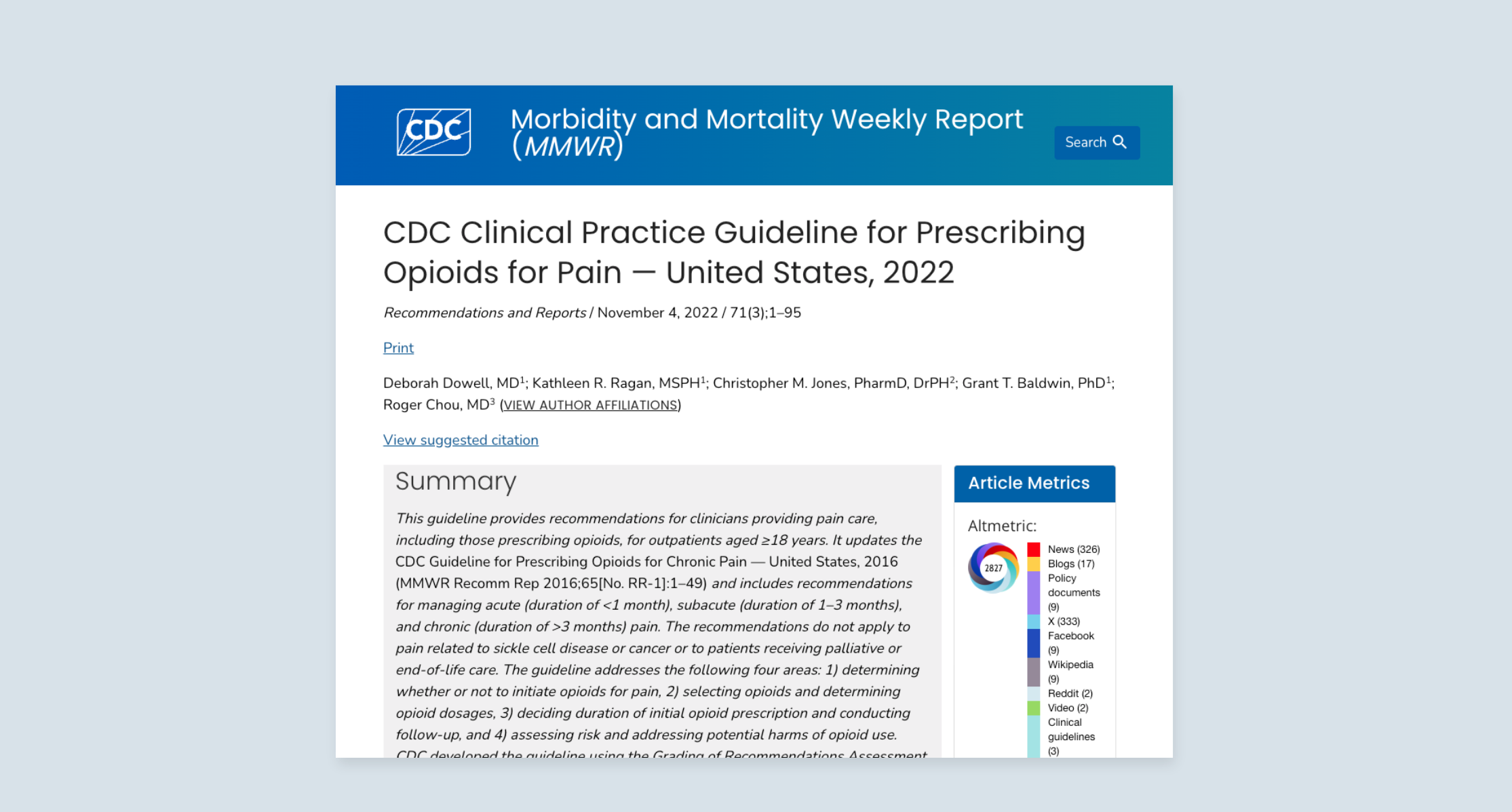
CDC guidelines
Enhancing health policy through public engagement
Year: 2021 – 2022
Partner: Centers for Disease Control and Prevention
Team: Lab at OPM
Role: Researcher
Sector: Federal government
Links: CDC Clinical Practice Guidelines for Prescribing Opioids for Pain
Partner: Centers for Disease Control and Prevention
Team: Lab at OPM
Role: Researcher
Sector: Federal government
Links: CDC Clinical Practice Guidelines for Prescribing Opioids for Pain
Background
Since the release of the original 2016 guideline on pain management, new evidence and widespread feedback have highlighted the need for more flexible, patient-centered approaches. The CDC’s engaged the Lab at OPM to support engaging the chronic pain community to help address concerns about misapplication of the prior recommendations, disparities in pain management, and unintended consequences such as untreated chronic pain and stigma. How might we inform CDC’s guidelines that integrate diverse stakeholder voices, balance public health goals with individual patient needs, and adapt to evolving evidence and contexts?
Approach
The Lab at OPM supported CDC by designing and implementing a wide public engagement process. Through conversations, stakeholder workshops, and public commentary, the team was able to engage diverse stakeholder perspectives, including those of patients, healthcare providers, and advocacy groups. By employing thematic analysis, the team identified key concerns such as stigma, access barriers, and provider hesitancy. The insights informed patient-centered recommendations, fostering better communication, equitable care, and safer prescribing practices.
Formation
During this phase, we aligned on the goals of the effort and planned the multimodal research effort with CDC, with our team leading the qualitative.
How I contributed:
-
Team formation and charter with the qualitative research subteam
-
Set cadence with CDC stakeholders
-
Outlined qualitative research goals
-
Planned sampling, research questions, recruitment, incentives, data storage, and how to take a trauma-informed approach
Discovery
The discovery phase involved three months of conversations with the chronic pain community.
How I contributed:
-
Research logistics and communication
-
Ongoing interviews with pain providers, chronic pain community
-
Ongoing synthesis process
-
Research debriefs and reporting on initial insights
-
Coordination with CDC stakeholders to shadow
Design
The design phase was primarily focused on how to give form to insights for translation to CDC.
How I contributed:
-
Workshop planning for synthesis with CDC stakeholders
-
Creation of artifacts such as user stories, journey maps, synthesis summaries, and research reports
Implementation
The final phase was to support CDC in the guidelines, and to help inform other CDC efforts.
How I contributed:
-
Research contributions to the published CDC guidelines
-
Summary of programmatic opportunities for CDC
-
Documented process and impact on benefits of using human-centered design process in the health policy process
Methods and insights
Planning for open-ended conversations to capture lived experiences
The engagement focused primarily on discovery research, and CDC brought a plethora of experience in multi-modal research. The initial task for the team was to understand what contribution the Lab at OPM could bring to this collective skillset, and what type of conversations would complement the existing CDC process. The Lab at OPM developed a number of research planning and design tools to help visualize how we would support public engagement, recruitment, outreach, sampling, and open-ended conversations in an ethical and trauma-informed way so that we could capture the lived experience of the chronic pain community.
Modeling future human-centered CDC processes
Because we were bringing new approaches to not just public engagement, research, but also to making sense of what was learned, the Lab team made sure to build in moments of reflecting on the process, bringing CDC stakeholders and leaders along in conversations to shadow, and co-designed a number of the synthesis frameworks and workshops in tandeem with CDC stakeholders who would continue the work after the partnership.
What we accomplished
The updated 2022 guideline focused on patient-centered care and flexible approaches to pain management. Key recommendations include evaluating risks and benefits of opioids versus non-opioid therapies, starting with the lowest effective dose, reassessing the need for opioids regularly, and addressing potential harms. The guidelines also emphasize improving communication between clinicians and patients to ensure individualized and equitable care.
Impact
The updated guidelines serve as a model for integrating qualitative methods into public health policymaking. It addresses the need for equitable, evidence-based pain management while considering the complexities of opioid misuse. The guideline demonstrates how qualitative data can shape healthcare practices by prioritizing lived experiences and stakeholder insights. The process not only modeled a process for integrating public engagement and qualitative research into the development of health policy and guidelines, but also launched additional human-centered design initiatives within the CDC Injury Center, embedding more inclusive and participatory approaches in future projects.