High-impact service providers
Setting the standard for federal service delivery
Year: 2021 – 2022
Partner: White House and the Office of Management and Budget (OMB)
Team: Lab at OPM
Role: Service Designer, Program Strategist
Sector: Federal government
Links: Performance.gov/cx
Partner: White House and the Office of Management and Budget (OMB)
Team: Lab at OPM
Role: Service Designer, Program Strategist
Sector: Federal government
Links: Performance.gov/cx
Background
The federal government serves millions daily, yet many remain difficult to access, inefficient, or frustrating. These experiences – whether applying for benefits, navigating a website, visiting a national park, or receiving disaster assistance – directly impact public trust in government. The Office of Management and Budget (OMB) partnered with the Lab at OPM to find ways to promote service standards across the entire federal government. How might the White House advance service design improvements that improve consistency, reduce burden, and strengthen public trust in federal service delivery?
Approach
To enhance and scale the program’s impact, OMB partnered with The Lab at OPM, aiming to make the program more effective and user-friendly for federal teams. This collaboration sought to streamline how high-impact service providers (HISPs) met service delivery standards, establish consistent public surveys for continuous improvement, assess organizational capacity for service delivery, and develop actionable plans with specific yearly goals that both align with the agency’s strategic plan but also respond to direct feedback from the public.
Discovery
How I contributed:
-
Internal team alignment
-
Review of policy landscape and budget process
-
Stakeholder mapping
-
Review past service guidance
-
Reviewed high impact services
-
Conduct interviews with agency teams
-
Set-up office hours
Design
How I contributed:
-
Outline program goals
-
Program outline and defining detailed audience and services
-
Prototyping templates and guidance with agency teams
-
Ongoing feedback in office hours
Implementation
How I contributed:
-
Implement the service standards program
-
Iterate on touchpoints
-
Ongoing feedback in office hours
Scale
How I contributed:
-
Support OMB hiring for portfolio managers
-
Refine program and deliverables for scale
-
Document impact
-
Finalize max.omb platform with program materials
Methods and Insights
Research into the policy landscape
Past administrations have utilized OMB to make steady, iterative progress in strengthening service delivery, digital infrastructure, and design standards to improve how the government provides critical services to the public. We analyzed these various policies, guides, and executive orders to refine our program’s goals, objectives, and requirements.
Process mapping to understand entry points
Building upon the progress, we set out to answer: how might we advance service design improvements within the existing federal budget and planning cycle that improve consistency, reduce burden, and strengthen public trust in federal service delivery?
Understanding stakeholders and their needs
We hoped to better understand who within each agency/department had the authority to make decisions, had strong feedback loops with their users, and had the ability to effectively roll-out service standards to others in their environment. Stakeholder mapping was essential in helping us identify who, and how, to bring each of the various people into the process with us to navigate the program and make decisions.
Defining design principles to guide the program
We developed service principles from early discovery, along with good practices for service delivery, which helped to shape the long-term goals of the program and all the artifacts and templates we had produced to reinforce these principles.
Prototyping service definition templates and capacity building tools
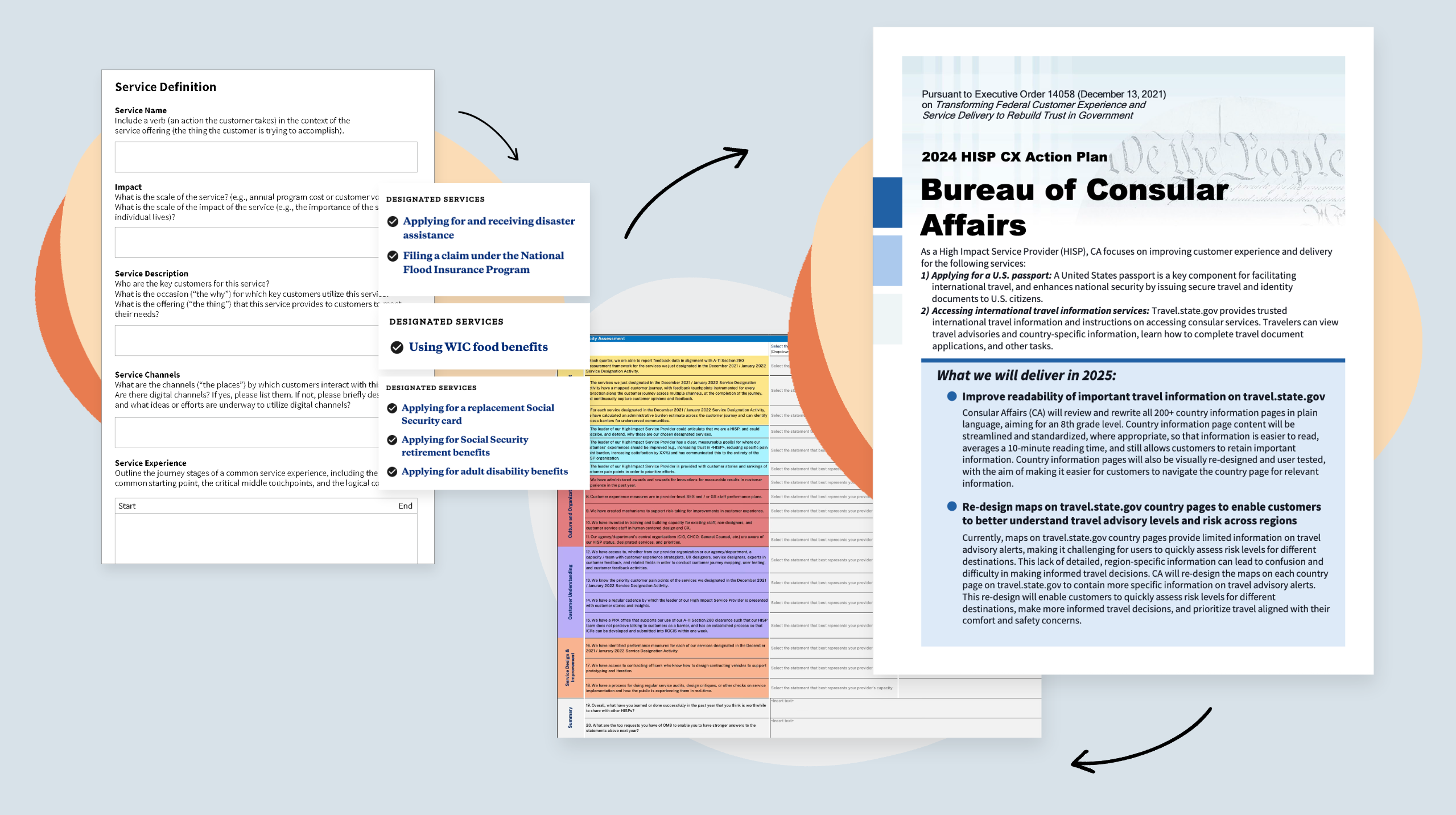
Once we had a good sense of the challenges, defined our principles, and reviewed the budget cycle, we started prototyping tools and templates that could help agency teams articulate their high-priority services, who their primary beneficiaries were, what their main challenges were when engaging with the service, and metrics that help to define success. To support federal agencies in defining their programs and services using service design good practices, we created a reusable service definition workshop and worksheet. The workshop focused on breaking down service design concepts like backstage and frontstage, and produced sketch service blueprints as a workshop output.
What we accomplished
We designed and implemented a service-design program that layered onto the federal budget cycle and supported agencies in making ambitious service improvements. All of the process templates, such as service definition, service blueprinting, and maturity modeling, culminated in action plans with annual commitments to address key service gaps. We provided hands-on facilitation to agencies and their leadership at critical stages, helping them reach a shared understanding of the broader service improvement efforts that needed to be embedded in both budgeting and strategic planning processes. To increase visibility and celebrate progress, The Lab also helped communicate the program’s impact through performance.gov, showcasing the HISPs’ successes and the tangible benefits of the initiative. The effort raised the standard for service delivery at the federal level, strengthened public trust in government services, and resulted in meaningful improvements to the critical programs millions of Americans rely on every day.
Impact
We successfully integrated service standards into the federal budget and planning process.
In addition, we institutionalized accountability for service quality, designated 36 departments as high impact service providers and identified 70 high-impact federal services, each advancing targeted service improvements, improved public trust, with 75% of users of high-impact services reporting confidence in their agency, coordinated cross-government efforts. Cross-government efforts that stemmed from this work included: survey alignment to streamline measurement, expanded language access to increase inclusivity, expedited research clearance (PRA fast track) to speed insights into action, and coordinated hiring for service improvement roles to strengthen agency capacity.