IRS Direct File
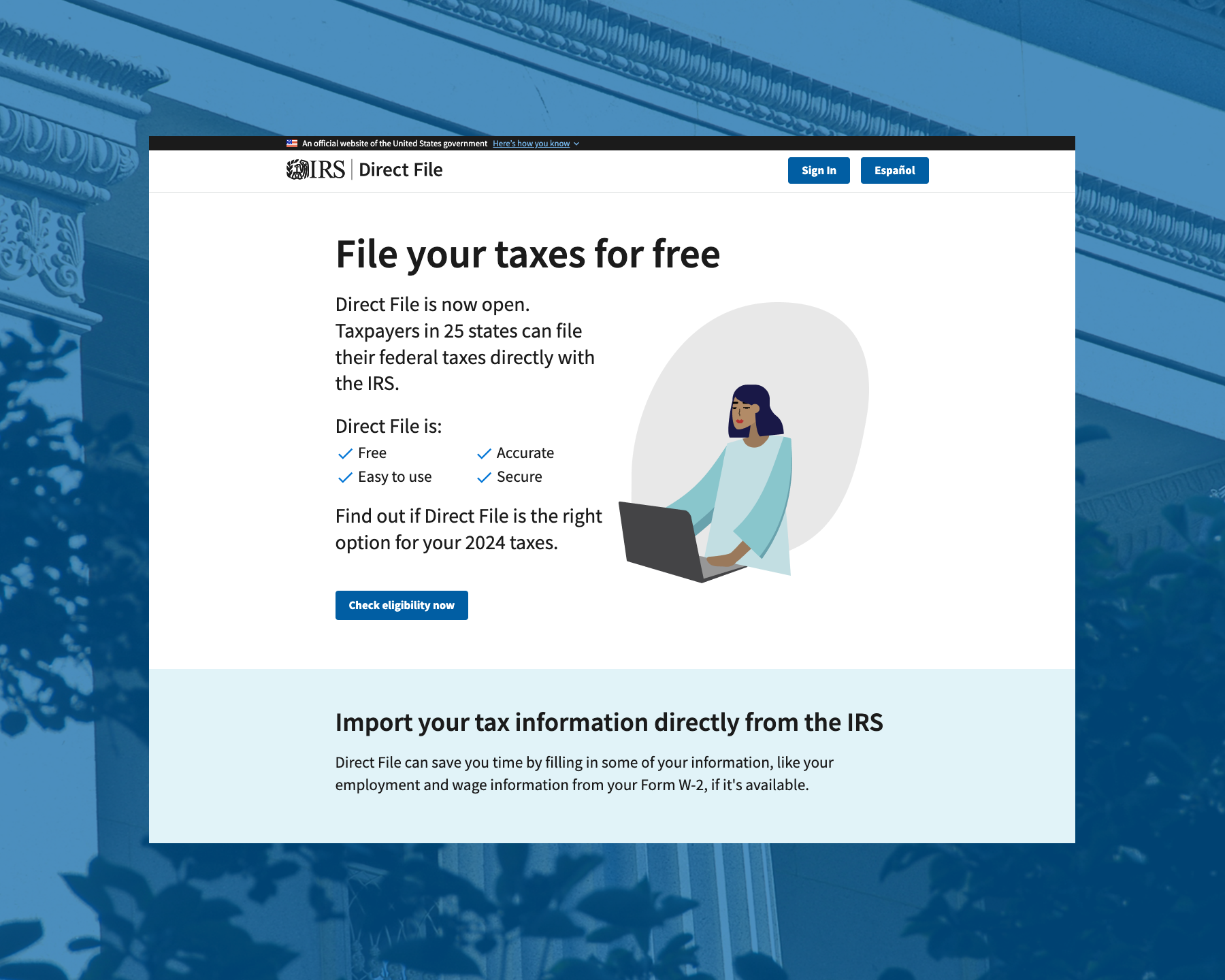
Filing taxes for free with the federal government
Year: 2023 – 2024
Partner: The U.S. Department of Treasury, and the Internal Revenue Service (IRS)
Team: IRS, USDS, 18F, Truss, Coforma
Role: Service Designer, Program Strategist
Sector: Federal government
Links: Direct File, Final Report
Press: New York Times, The Atlantic
Partner: The U.S. Department of Treasury, and the Internal Revenue Service (IRS)
Team: IRS, USDS, 18F, Truss, Coforma
Role: Service Designer, Program Strategist
Sector: Federal government
Links: Direct File, Final Report
Press: New York Times, The Atlantic
Background
On average, people spend 9 hours and roughly $160 on filing taxes annually, which equals $11 billion in fees and time costs annually.
Because of those burdens, 9 million people may not be filing and receiving the benefits they are entitled to each year. Additionally, many federal aid programs, such as the Child Tax Credit and Earned Income Tax Credit, are distributed through the tax system, and one in five eligible taxpayers don’t claim these valuable credits. Although taxpayers have options for preparing their tax returns, there was previously no easy, free, online way to do so with the Internal Revenue Service (IRS), which shaped their opinions of the agency. How might we create a free, public tax filing option for U.S. taxpayers with hands-on and responsive customer support, so that they can easily access the refund and benefits they’re entitled to without unnecessary barriers?
Approach
Starting in June 2023, USDS and 18F partnered with Treasury and the IRS to develop the Direct File pilot with a scheduled launch date of January 2024. IRS, USDS, and 18F worked closely to create blended agile teams. This approach allowed the Direct File team to demonstrate new design and agile development methods to the IRS, with small teams delivering iterative improvements to build the product. The collective team set design, security, usability and accessibility standards from the start to ensure the Direct File pilot would be user-friendly and could be completed within the set timeline. As a service designer on the project, I was dedicated to the customer support, feedback loops, and ongoing research agile sprint teams.
Discovery
Early phase of the work to get a sense of the current policy landscape, tax scope, and team structure.
How I contributed:
-
Discovery on current state of customer support delivery at IRS, policy limitations
-
Outlined three operating models for the support layer
-
Aligned requirements and goals for support layer
-
Supported research on general tax scope
Design
The team never left discovery behind, but moved into prototyping to give shape to the new product and service.
How I contributed:
-
Finalized service blueprint for customer support experience
-
Designed feedback loop methods
-
Supported the creation of service touchpoints
-
Outlined technical requirements for customer support
-
Supported research sprint on login, checklist
Implementation
Ahead of launch, the team moved into implementation and delivery of the phased pilot, iterating along the way.
How I contributed:
-
Set up a system for ongoing learning from taxpayers to product team
-
Implemented training for 300 CSRs and their operational set-up
-
Designed on-call and escalation process for urgent issues
-
Supported research sprint on tricky tax situations
Scale
Throughout the pilot launch, we made iterative changes and documented lessons learned for scaling.
How I contributed:
-
Iterated on scripts, service touchpoints, escalation flow
-
Implemented daily, weekly, and escalation feedback loops
-
Supported research and design sprint on rejection experience
-
Summarized learnings for scaling and sustaining Direct File
Methods and Insights
Engaging front-line staff as partners
By conducting multi-day onsites with the IRS customer support reps, we were able to learn directly what challenges they faced, what systems they used, and what they hoped for the future of a new customer support service with Direct File.
Mapping the tax and IRS policy landscape
We supported a deeper look at the existing IRS policies especially in relation to customer support, the 1040 form itself, VITA training materials that summarized the complex tax code and how to train on it, and other existing guidance that would impact how we implemented, collected data, supported taxpayers, and what policy changes we needed to advocate for within the work.
A living service blueprint to guide rapid prototyping
We developed a living service blueprint to ground the customer support layer while we conducted rapid prototyping of a variety of digital and non-digital touchpoints from FAQs, the customer support knowledge base, product features, escalation of issues, and case management. The service blueprint helped the team visualize gaps, align sprint teams on our delivery, revealed failure points and dependencies, and helped us think, make and iterate.
Feedback loops for ongoing learning
We created daily CSR surveys, escalation ticket system, and a reporting and shareout structure for both quantitative and qualitative data. This helped us validate sprint goals for UX designers, engineers, and product managers, surfaced high-impact issues quickly, added narrative context to our reporting, created a structured rhythm across the team, and acted as an output to funnel up to leadership.
Summarized learnings throughout for scale
The team worked together during the month after the pilot to reflect, document, and strategize about the future of the pilot. From a service design perspective, I helped to inform the planning across a number of areas including customer support technology and procurement planning, organizational design, future customer support experience, strategy for feedback loops and escalation.
What we accomplished
We launched a new IRS service that allows taxpayers to easily file taxes online directly with the IRS, for free and a responsive chat-based customer support. The Direct File pilot was gradually introduced to taxpayers over several weeks, starting in January 2024. The pilot approach allowed the team to thoroughly test the new service and continuously improve the taxpayer experience before making it available to larger audiences. Direct File guided taxpayers through answering questions to prepare their tax return step-by-step, offered hands-on taxpayer customer support, integrated with State taxes where applicable, and connected to taxpayer’s online account for return and refund tracking.
Impact
Over 140,000 people in the 12 pilot states filed their taxes for free directly with the IRS and received over $90 million in federal tax refunds.
Those federal tax refunds provided access to the Earned Income Tax Credit and Child Tax Credit, two of the country’s largest and most effective antipoverty and anti-child-poverty programs. In addition, we set a precedent for what is possible for future government services, first-time filers received the benefits they were entitled to and we reduced the overall burden of doing taxes, clarified tax concepts through plain language in both English and Spanish, provided an accessible experience, derisked the launch by testing and iterating with taxpayers, and supported the public by expanding IRS customer support channels.