Cross-agency projects
Redesigning services for life’s critical moments
Year: 2021 – 2022
Partner: Office of Management and Budget (OMB)
Team: Lab at OPM
Role: Service Designer, Program Strategist
Sector: Federal government
Links: Performance.gov
Press: Federal News Network
Partner: Office of Management and Budget (OMB)
Team: Lab at OPM
Role: Service Designer, Program Strategist
Sector: Federal government
Links: Performance.gov
Press: Federal News Network
Background
Too often, people have to navigate a web of government websites, offices, and phone numbers to access the services they depend on. Government must meet people where they are and be responsive to how they navigate important moments in their lives such as having a child, navigating a financial shock, recovering from a disaster. How might we design public services around people’s life events—rather than agency lines—to increase access when it matters most?
Approach
The OMB CX team engaged the Lab at OPM to run a pilot program that launched cross-agency projects, organized around people’s critical life events. The Lab at OPM partnered with OMB to support the initiative, establishing tools, templates, project plans, and research resources to guide cross-agency collaboration. This effort introduced a new model for federal service delivery, emphasizing teamwork across agencies and levels of government. By centering the public’s needs, rather than operating within traditional bureaucratic silos, the pilot sought to identify and implement solutions that reflect how people actually experience these life moments.
Formation
Early phase of the work to define effort’s overall goals, stakeholder landscape, and the scope.
How I contributed:
-
Supported the creation of design brief and scope documents
-
Supported initial request for proposals for life experiences
-
Defined roles and responsibilities for the management team
-
Facilitated the process to define the life experiences, project teams, and charters
Discovery
Once scope was defined, the work shifted to supporting the five life experience teams in their discovery work.
How I contributed:
-
Facilitated cross-team stand-ups and retros
-
Supported research planning, PRA approvals, and discovery logistics
-
Designed and facilitated measurement workshop
-
Supported ongoing reporting to leadership and administration
Design
The discovery led the five life experience teams to define a range of interventions, requiring different support.
How I contributed:
-
Supported the creation of blueprint, journeymap, and presentation templates
-
Supported cross-project reporting and presentation summaries
-
Documented the overall cross-agency project model
Implementation
The management team supported moving the recommendations into action and implementation.
How I contributed:
-
Supported the budget and implementation planning process
-
Supported summarizing progress and interventions to the public
Methods and insights
Tapping into civil servants institutional knowledge
The team first sourced proposals for what life experiences to focus on from across the federal government staff, hoping to to source both the lived and learned experience of civil servants who are close to the problems their beneficiaries face. The general call spurred a number of proposals and included detailed research and problem-definition because the proposals were coming from those who had institutional knowledge and experience working in the problem space for years.
Utilizing existing government infrastructure
To narrow and refine the proposals to the life experience the pilot would focus on, the combined management team utilized existing government infrastructures and platforms to source feedback from the public, to engage federal political appointee leadership across agencies, and to assess the potential impact of the different proposals, ultimately landing on five selected life experiences: recovering from a disaster, having a child, facing a financial shock, approaching retirement, and navigating transition to civilian life.
Forming and setting up life experience teams for success
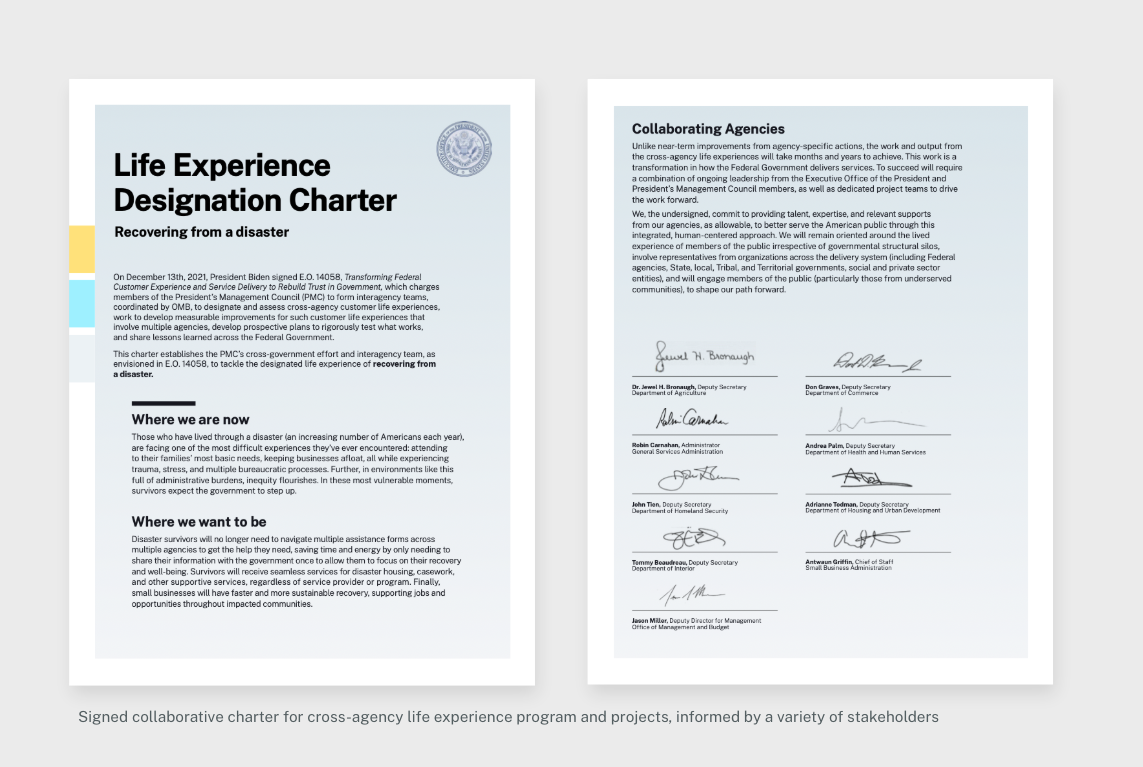
Because there were multiple projects to move forward within the overall life experience pilot, the management team was faced with a challenge of keeping the work aligned across the differing project landscapes. The management team used a few tactics to jump start the projects and to hold them together: setting up an empowered project lead with experience in the project-space who would be positioned within OMB temporarily through a detail, forming project charters that agency leadership would align on and sign for overall buy-in, and supporting procurement and partnerships to form public+private teams of relevant researchers, designers, and leaders for each of the life experiences.
Designing tools and templates for research and design
In addition to supporting the team formation, the management team provided each of the five life experience teams with tools and templates for them to jump into the detailed discovery and design work, so their time could be spent on the work that mattered – talking with those most impacted in the problem space, making sense of insights, and identifying cross-agency opportunities to move forward with. The tools and templates ranged from research clearance support, research data protocols, consent form management, recruiting, measurement and evaluation frameworks, journey maps and service blueprint templates, and facilitation of leadership reporting.
What we accomplished
We launched five successful workstreams that led to over 15 service improvement pilots focused on five life experiences: recovering from a disaster, facing a financial shock, approaching retirement, having a child, and navigating to civilian life.
Impact
We successfully designed and launched a cross-agency collaboration model that united 36 federal agencies and 34 states/territories, breaking silos to improve service delivery, engaged 500+ members of the public to directly inform policy and program decisions, catalyzed 15+ pilot projects through a life experience–driven discovery and design process. Notable pilots include: trauma-informed frontline staff training. administrative burden calculator to reduce barriers to access, improved data sharing for disaster recovery and income verification, and state-level benefit improvements and senior benefits linkage between HUD and SSA